table of contents
- Is it illegal to kill a raccoon in Ontario?
- Is it illegal to kill squirrels or chipmunks in Ontario?
- Is it illegal to kill a skunk in Ontario?
- Can you kill groundhogs in Ontario?
- Are glue traps illegal in Ontario?
- Which Ontario wildlife can you legally kill on your own property?
- What should you do if an animal is in your building right now?
- Who may trap or kill wildlife on private property in Ontario?
- What is the difference between a furbearer, nuisance wildlife and a species at risk?
- Do farmers need a trapping licence in Ontario?
- Can you trap nuisance wildlife at any time of year in Ontario?
- When do you need a trapping licence or ministry permit in Ontario?
- Which traps are allowed and which are banned?
- How often must you check a live trap in Ontario?
- Where can you release a live-trapped animal in Ontario?
- How can DIY trapping affect neighbours, insurance and safety?
- Where is trapping prohibited in Ontario?
- When can you act yourself, and when should you call a professional?
- What does a licensed wildlife removal company do differently?
- Do I need a licence to trap animals in Ontario?
- Which kills must be reported to the ministry in Ontario?
- Where can you check Ontario’s official wildlife rules?
- How do you stay compliant when dealing with nuisance wildlife?
- Why does relocating wildlife cause problems?
- What prevention steps work for Ontario homeowners?
- How does Diamo Pest Control handle nuisance wildlife?
- Is it legal to trap animals on your property in Ontario without a licence?
- Can I relocate a trapped animal somewhere else in Ontario?
- What animals are illegal to trap on private property in Ontario?
- What happens if I trap wildlife illegally in Ontario?
- When should I call a professional instead of trapping wildlife myself?
Key takeaways
- Is it illegal to kill a raccoon in Ontario? Not when the raccoon is damaging, or about to damage, your property — the same rule covers squirrels and skunks, and it applies only to the landowner, immediate family or a qualifying agent using a legal method.
- Wildlife that is simply present does not qualify. A raccoon crossing the lawn is not a raccoon tearing open a soffit.
- Poisons and adhesive (glue) traps are prohibited by the Fish and Wildlife Conservation Act, 1997, and municipal by-laws ban firearm discharge across virtually all of the GTA.
- A live-trapped animal must be released within 1 km of where it was caught, within 24 hours, on private property and only with that landowner’s permission.
- Wildlife removal businesses may capture and release problem animals, but not kill them. Licensed trappers, hunter-accredited Outdoors Card holders and municipal wildlife staff are the agents allowed to kill.
- Deer, elk, moose and caribou may not be harassed, captured or killed even when they damage property, and species at risk need an Endangered Species Act permit.
- Illegal trapping carries fines of up to $25,000 for individuals and $100,000 for corporations under the Act.
- Exclusion — a one-way door plus sealed entry points — is what stops a problem recurring, because a released animal stays inside its own home range.
Short answer: In Ontario you may harass, capture or kill most wildlife that is damaging your property, without a trapping licence, if you are the landowner, immediate family or a qualifying agent. The method rules are strict: no poison, no glue traps, firearms banned by most GTA by-laws, and live-trapped animals released within 1 km and 24 hours. This guide from Diamo Pest Control & Wildlife answers the question species by species, then covers licences, legal traps, release rules and penalties.
Is It Illegal to Kill Raccoons, Squirrels or Skunks in Ontario?
Not automatically — but the exceptions are narrower than most property owners assume. Under Ontario’s Fish and Wildlife Conservation Act, 1997, a landowner, immediate family or a qualifying agent may harass, capture or kill wildlife that is damaging or about to damage their property, without a trapping licence. Wildlife that is simply present, or merely unwelcome, does not meet that bar.
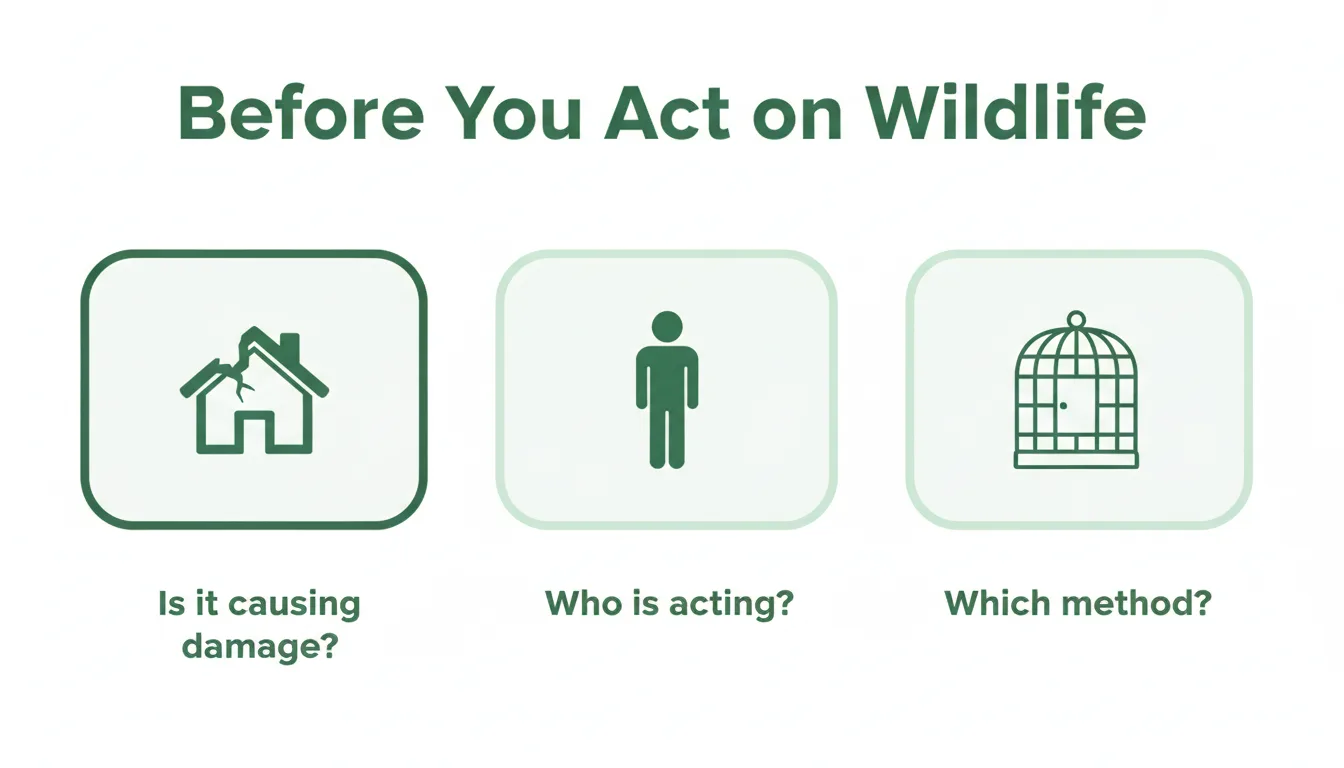
The species rarely decides the answer. Three questions do:
- Is the animal actually causing damage? A raccoon tearing open a soffit is a different legal situation from a raccoon crossing the lawn.
- Who is acting? The exemption covers the owner, immediate family and qualifying agents — not a neighbour, and not a friend doing you a favour.
- Which method? Poisons and adhesive traps are prohibited, body-gripping traps have size limits, live-trapped animals must be released within 1 km and 24 hours, and municipal firearm by-laws rule out shooting almost anywhere urban or suburban.
Ontario’s own guidance adds three conditions that apply to every species: do not harass, capture or kill more wildlife than is needed to protect your property, keep the activity on your own property, and do not cause unnecessary suffering. Killing is treated as a last resort.
Is it illegal to kill a raccoon in Ontario?
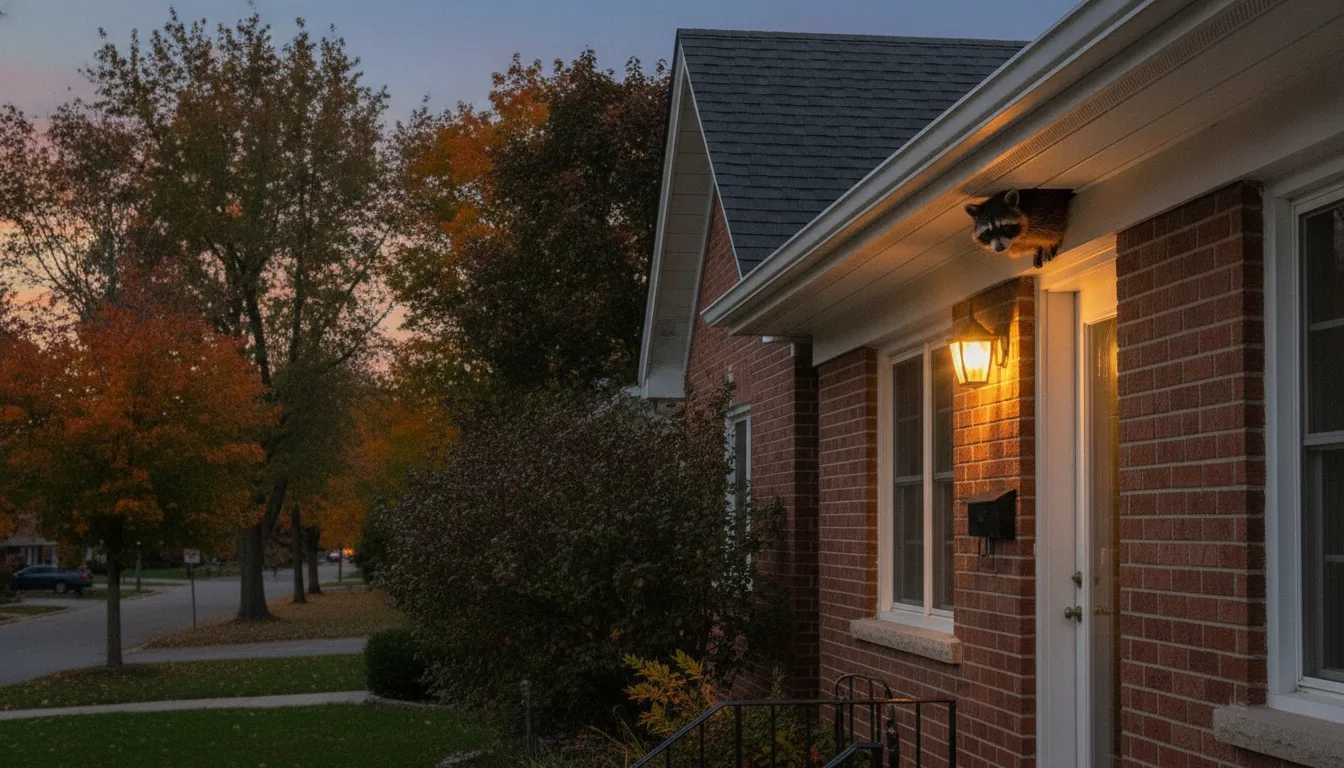
No, if the raccoon is damaging your property and you use a legal method — yes, in almost every other case. Raccoons are a furbearing mammal under the Fish and Wildlife Conservation Act. An opened soffit, a torn roof vent or insulation shredded in the attic meets the damage test, and the property-protection provision then lets the landowner act without a trapping licence.
Two rules close that door quickly in the GTA. Discharging a firearm is prohibited by municipal by-law across virtually all of Toronto and the surrounding regions. A live-trapped raccoon must be released within 1 km, within 24 hours, and a raccoon covers 1 km easily. A mother raccoon separated from her kits will work hard to get back to them, so DIY trapping in spring often ends with the same raccoon back in the same attic and a litter sealed in the ceiling.
The approach that resolves a raccoon problem is exclusion: a one-way door on the active entry, every secondary gap sealed, and the entry points repaired so the next raccoon cannot reopen them. See raccoon removal.
Is it illegal to kill squirrels or chipmunks in Ontario?
Squirrels and chipmunks follow the same property-damage rule as raccoons: legal for the landowner when the animal is damaging the property, with the same method restrictions and the same 1 km release limit for anything live-trapped. Squirrels are the most-searched species after raccoons, and trapping and relocating them is both legally constrained and, over a season, largely futile.
Grey squirrels re-enter at roof edges, vents and chewed fascia, and an attic that housed one squirrel will house the next. The bigger risk is what a squirrel does once inside: squirrels gnaw, and chewed wiring is a fire hazard. Chipmunks fall under the same rules, though chipmunk damage is usually to grade-level structures and gardens rather than roofs.
Sealing and exclusion is the durable fix for squirrels. See squirrel removal.
Is it illegal to kill a skunk in Ontario?
A skunk damaging your property — typically by denning under a deck, porch, shed or foundation — falls under the same property-protection provision as other wildlife. Ontario also allows a skunk den or fox den to be removed without ministry approval, which is not true for other furbearing mammals.
Two practical cautions apply. Skunks are a rabies-vector species in Ontario, so a skunk behaving unusually is a public-health matter, not a DIY one. A skunk handled badly under a deck will spray into the enclosed space beneath the house, and the smell outlasts the skunk. Diamo confirms no young are present before any skunk exclusion work. See skunk removal.
Can you kill groundhogs in Ontario?
Yes, a landowner may act against a groundhog (woodchuck) that is damaging the property, under the same method rules and the same 1 km release limit. Groundhog burrows undermine sheds, patios, walkways and foundations, which plainly meets the damage standard in the Fish and Wildlife Conservation Act.
A groundhog burrow system is usually larger than the one hole you can see, and a burrow left open is simply re-occupied by the next groundhog. See groundhog removal.
Are glue traps illegal in Ontario?
Yes, for wildlife. The Fish and Wildlife Conservation Act prohibits using an adhesive to capture or kill wildlife, alongside the prohibition on poison. That holds regardless of how a glue-trap product is marketed in a hardware aisle.
A glue trap also does not kill quickly, and an animal found suffering on one raises animal-welfare questions that sit outside wildlife law entirely. Diamo Pest Control does not use glue traps on any job. If you are weighing a specific product for a specific species, check it against the Act or with the Ministry of Natural Resources before you buy it.
Which Ontario wildlife can you legally kill on your own property?
Most common nuisance species can be dealt with under the property-damage rule; a few cannot be touched at all. This table summarises the position for a landowner whose property is being damaged.
Source: Government of Ontario, Harass, capture or kill a wild animal damaging private property.
What should you do if an animal is in your building right now?
For most GTA property owners the law probably does permit you to act, but the methods left after the by-laws and device restrictions rarely solve the problem. The 1 km release rule means a live-trapped animal is released inside its own home range, and it usually comes back.
That is the gap a licensed wildlife professional fills — not permission, but method. Exclusion work removes the animal and closes the route it used, which is the part that stops it recurring.
Diamo Pest Control & Wildlife is licensed and insured, and works across Toronto and the GTA with 24/7 emergency availability. Call (647) 901-6024 or request a free estimate. Inspections are $85, waived when you book the work.
This page is general information about Ontario wildlife law, not legal advice. Rules change and municipal by-laws differ — confirm anything you intend to rely on against the Fish and Wildlife Conservation Act, 1997 or with the Ministry of Natural Resources. Last reviewed 16 October 2026.
What Does Ontario Law Say About Trapping Wildlife on Private Property?
Ontario’s Fish and Wildlife Conservation Act, 1997 sets the rules for all animal trapping on private property. It separates two situations: property protection, where a landowner deals with wildlife causing damage, and licensed trapping, where a trapper harvests furbearers under a licence, season and quota. Which situation you are in decides what you may do.
Who may trap or kill wildlife on private property in Ontario?
The landowner, immediate family and a short list of qualifying agents — and the agent’s credential decides what the agent may do. Ontario’s guidance says a wildlife agent can act only when the landowner asks, and the agent must fall into one of these groups:
- Immediate family of the landowner.
- A licensed trapper holding a valid Ontario trapping licence.
- An Outdoors Card holder with hunter accreditation — to harass or kill, but not to capture.
- A person employed by a municipality to control wildlife.
- A wildlife removal business — to capture and release only, not to kill.
- A person authorized by the ministry.
Licensed trapping for fur is a separate activity. A trapper harvesting pelts needs a provincial trapping licence, must follow open seasons, quotas and approved traps, and needs written permission from the landowner to trap on land the trapper does not own.
What is the difference between a furbearer, nuisance wildlife and a species at risk?
A furbearer is a legal category, nuisance wildlife is a situation, and a species at risk is a protected status. Furbearing mammals — such as raccoon, mink, muskrat, beaver, fox and coyote — are the most tightly regulated for harvest. Nuisance wildlife means an animal actively causing property damage, which a landowner may deal with under the property-protection rule.
Species at risk, such as endangered bats or the eastern foxsnake, are listed under Ontario’s Endangered Species Act, 2007. Damage to property does not override that listing: harming a species at risk needs a permit or authorization. Ontario law also defines what counts as trapping, which includes live-capture cage traps, body-gripping devices and exclusion devices such as one-way doors.
When Is Trapping Permitted on Private Property in Ontario?
Trapping on private property is permitted when wildlife is damaging, or about to damage, the property — for most non-endangered species, without a licence, and at any time of year. The landowner, immediate family and qualifying agents may act. What changes from case to case is the method, the species and who does the work.
Do farmers need a trapping licence in Ontario?
A farmer does not need a licence to deal with wildlife threatening crops or livestock on the farmer’s own land. The same property-protection rule applies. A licence becomes mandatory as soon as pelts or furbearer parts are sold. Municipal staff may also intervene without a trapping licence, but must follow the same humane standards.
Can you trap nuisance wildlife at any time of year in Ontario?
Yes. Property protection has no open season — it is allowed year-round when wildlife causes, or is about to cause, damage. Fur harvesting is the activity limited to open seasons. In cities, traps near neighbours or shared buildings draw closer scrutiny. In rural Ontario more conflicts qualify as nuisance cases, but the same humane-care rules apply everywhere.
When do you need a trapping licence or ministry permit in Ontario?
A trapping licence is needed to trap for fur harvest or sale, even on your own land. A ministry approval or permit is needed to:
- Destroy the den of a furbearing mammal or a black bear (fox and skunk dens are the exception).
- Relocate a live black bear.
- Harass, capture or kill a species listed as extirpated, endangered or threatened.
Professional trappers harvesting fur work within Wildlife Management Unit (WMU) quotas and open seasons. Keep a record of every action you take under the property-protection rule — photos, dates and written permissions.
Which Traps and Methods Are Legal in Ontario?
Legal methods are live-capture cage traps, certified body-gripping traps within size limits, and exclusion devices. Poison and adhesive traps are prohibited outright, and firearm discharge is banned by municipal by-law across most of the GTA. Every method must avoid unnecessary suffering.
Which traps are allowed and which are banned?
Allowed:
- Live-capture traps (cage or box traps).
- Certified body-gripping traps for certain furbearers, within size and placement limits.
- Relaxing cable restraints — for coyote and wolf only, used by licensed trappers or qualifying farmers.
- Exclusion devices such as one-way doors.
Banned:
- Any poison or toxic bait.
- Adhesive (glue) traps for wildlife.
- Oversized body-gripping traps (jaw spread over 18 cm) set on land.
- Uncertified or homemade devices.
How often must you check a live trap in Ontario?
At least once every 24 hours. Live-holding traps must be checked daily south of the Canadian National Railway main line, which covers Toronto and the GTA. A captured animal should be dealt with promptly, and every trap should be kept in working order and away from public trails, parks and high-traffic areas.
Where can you release a live-trapped animal in Ontario?
Within 1 km of where it was captured, within 24 hours, and on private property only with the landowner’s permission. Moving a raccoon, squirrel or skunk farther — to a park, a ravine or across a municipal boundary — is illegal without special authorization. Handle the animal carefully and transport it in a secure, ventilated carrier.
If an animal must be killed, Ontario law requires that it be dealt with humanely and without unnecessary suffering. Species at risk are a matter for the Ministry of Natural Resources, not the property owner.
What Are the Penalties for Illegal Trapping in Ontario?
Fines for offences under the Fish and Wildlife Conservation Act, 1997 can reach $25,000 for an individual and $100,000 for a corporation. The Ministry of Natural Resources investigates violations. Animal-cruelty charges are also possible when non-compliance injures an animal, kills a protected species or puts neighbours at risk.
A homeowner who injures a raccoon with a banned device can face a fine, and the insurer may question a related claim.
How can DIY trapping affect neighbours, insurance and safety?
DIY trapping creates risks beyond the fine.
- Improper traps and cornered animals injure people.
- Accidentally trapping a species at risk, such as the eastern foxsnake, means court dates and large penalties.
- A missed daily trap check puts children, pets and the trapped animal at risk.
- Insurance claims may be questioned after an unlicensed trapping incident.
- Neighbour complaints can prompt ministry investigations and city fines.
Where is trapping prohibited in Ontario?
Trapping is prohibited in provincial parks, Crown game preserves and conservation reserves, with no exceptions. Other restrictions apply:
- No den destruction for furbearing mammals or black bears without ministry approval (fox and skunk dens are the exception).
- Seasonal or temporary bans protect wildlife populations.
- Ministry emergency orders can override property-protection rights when public or ecosystem safety is threatened.
Setting a trap in the wrong place, during a restricted period or against a ministry order can lead to:
- Confiscation of traps and equipment.
- Loss of trapping privileges.
- Prosecution and a record.
Property Protection vs Licensed Trapping: What Is the Difference?
Property protection is a landowner dealing with wildlife that is damaging the property; licensed trapping is harvesting furbearers for pelts. Property protection needs no licence and runs year-round. Licensed trapping needs a licence, an open season and a quota. The table sets the two side by side.
When can you act yourself, and when should you call a professional?
You may act yourself when you own the damaged property (or are immediate family) and the animal is clearly a common species causing damage. Call a licensed wildlife professional when:
- The species is regulated, endangered or at risk, or you are not sure what it is.
- Animals are inside walls, attics or other hard-to-reach areas.
- Young may be present.
- You need documented, humane removal and repairs.
What does a licensed wildlife removal company do differently?
A licensed wildlife removal company removes the animal and closes the way it got in. Under Ontario’s rules a wildlife removal business may capture and release problem wildlife, not kill it, so the work centres on exclusion rather than trapping.
Diamo Pest Control & Wildlife is licensed and insured, with 10+ years of experience across Toronto and the GTA. Every job follows the same four steps — inspect, plan, treat, prevent: a thorough inspection, humane removal with one-way doors, sealing and repair of entry points, and written follow-up advice. Diamo backs the work with a 100% satisfaction guarantee.
Ontario Wildlife Trapping: Licences, Reporting and Official Sources
Most homeowners dealing with a nuisance animal need no licence and have nothing to report. The exceptions are fur harvest, which needs a licence, and a short list of species whose killing must be reported to the Ministry of Natural Resources.
Do I need a licence to trap animals in Ontario?
Not for property protection on your own land. The landowner and immediate family need no licence to deal humanely with wildlife damaging the property. A trapping licence is required to harvest pelts of furbearing mammals such as beaver, raccoon or fox, or to trap on land you do not own. A farmer acting on the farmer’s own land needs no licence, but needs one to sell pelts.
Which kills must be reported to the ministry in Ontario?
A black bear killed to protect property must be reported to the ministry within 24 hours. A wolf or coyote killed to protect property must be reported to the local ministry work centre in most of central and northern Ontario (WMUs 1-42, 46-50 and 53-58). Release rules for live animals are the same everywhere: within 1 km and 24 hours.
Where can you check Ontario’s official wildlife rules?
The authoritative sources are the Act and the province’s property-protection guidance.
- Fish and Wildlife Conservation Act, 1997 — the statute.
- Harass, capture or kill a wild animal damaging private property — the Government of Ontario’s plain-language guide.
- Ontario Hunting Regulations Summary — updated yearly.
- Your local Ministry of Natural Resources work centre — for WMUs, permits and unusual cases.
How do you stay compliant when dealing with nuisance wildlife?
- Confirm the damage and the species before setting any trap.
- Use only legal, humane devices — never poison or glue.
- Check traps every 24 hours and release within 1 km.
- Document everything — photos, dates and written permissions.
- Check the current rules each season, because licensing and species status can change.
How Do You Prevent Wildlife Problems Without Trapping?
Prevention means removing the reasons wildlife moves in: open entry points, accessible food and easy shelter. Sealing gaps, securing garbage and fitting one-way doors keeps raccoons, squirrels and skunks out without a trap, a release or a legal question.
Why does relocating wildlife cause problems?
A relocated animal loses its food sources, shelter and territory, and moving it can spread disease and expose pets and non-target animals to harm. That is one reason Ontario limits release to 1 km. Within that distance most raccoons and squirrels simply return, so relocation rarely ends a wildlife problem on its own — Ontario’s own guidance says to discourage the animal from coming back as well.
What prevention steps work for Ontario homeowners?
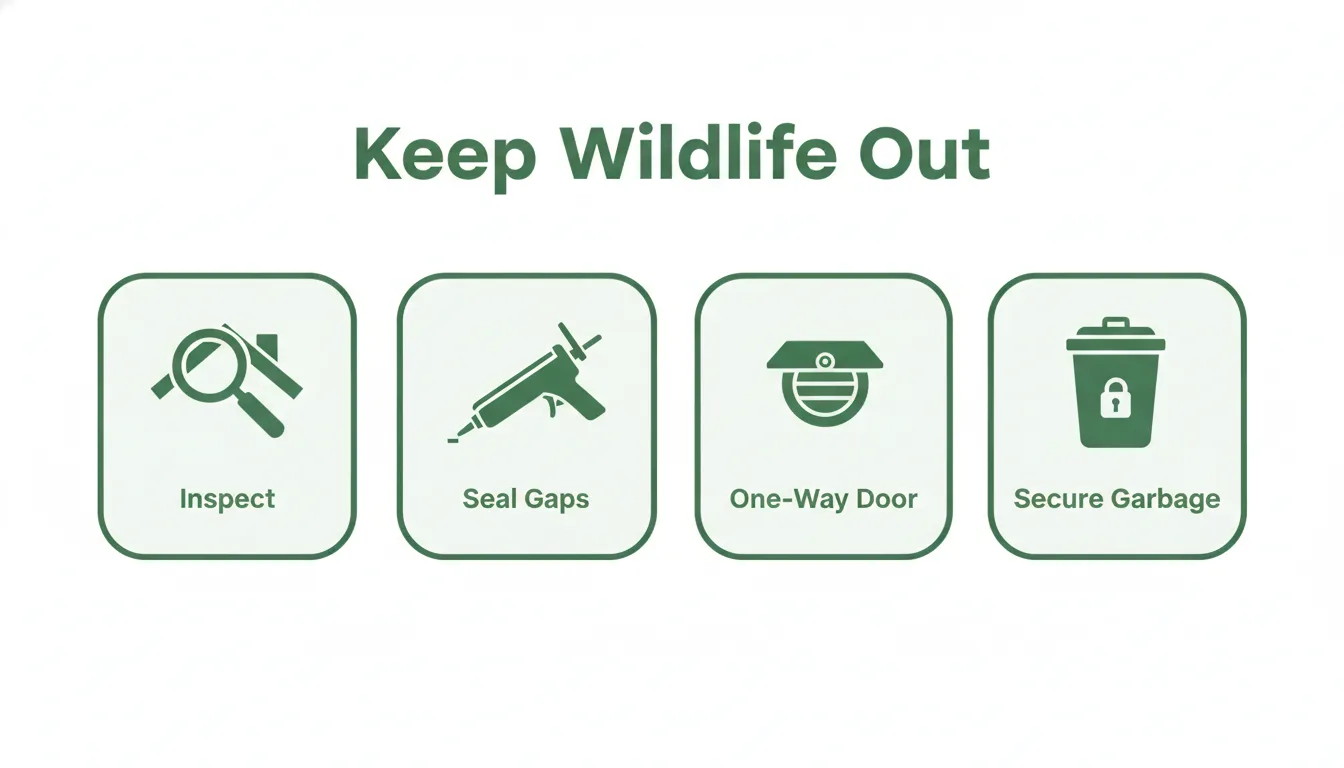
- Seal entry points: inspect attics, rooflines, soffits and vents for gaps larger than 2 cm.
- Secure food and waste: use bins with tight lids and remove fallen fruit and pet food.
- Install one-way doors: animals can leave but cannot return.
- Light vulnerable areas: motion-activated lights or sprinklers discourage night visits.
Night-time activity in a yard is normal for raccoons and skunks and does not by itself need intervention. A raccoon family crossing the yard at dusk is a reason to secure the garbage, not to set a trap.
How does Diamo Pest Control handle nuisance wildlife?
Diamo Pest Control uses humane exclusion, never toxic bait, glue traps or illegal methods. The licensed team follows the Fish and Wildlife Conservation Act’s humane standards and gives every client after-service guidance on wildlife-proofing the property so the problem does not return.
Summary: Staying Legal With Nuisance Wildlife in Ontario
Ontario lets property owners act against wildlife that is damaging their property, but only humanely, with legal devices, and within the 1 km / 24 hour release rule. Following those rules protects your property, your neighbours and Ontario’s wildlife, and keeps you clear of fines.
- Confirm the situation qualifies as property protection and identify the species before setting any trap.
- Use only certified, humane devices, check them daily and release within 1 km.
- Keep records — photos, logs and written permissions.
- Check the Government of Ontario guidance or your local ministry office before acting.
- Call a licensed, insured wildlife company for animals inside the building, young animals or protected species.
Diamo Pest Control & Wildlife handles raccoon, squirrel, skunk and groundhog removal across Toronto and the GTA, with 24/7 emergency service. Get your free estimate or see the wildlife control guide for Toronto and the GTA.
FAQs
Is it legal to trap animals on your property in Ontario without a licence?
Yes, when the wildlife is damaging your property and you are the landowner or an immediate family member. The trap must be humane and legal, poison and glue traps are prohibited, and a live-trapped animal must be released within 1 km and 24 hours. Many homeowners hire professional wildlife removal to avoid the legal risk. The Government of Ontario’s property-protection guidance sets out the rules.
Can I relocate a trapped animal somewhere else in Ontario?
No. Ontario requires live-trapped wildlife to be released within 1 km of the capture site and within 24 hours, on private property only with the landowner’s permission. Moving an animal farther is illegal under the Fish and Wildlife Conservation Act, 1997. A licensed provider of humane wildlife removal follows the legal release rules and seals the entry so the animal cannot return.
What animals are illegal to trap on private property in Ontario?
Deer, elk, moose and caribou may not be harassed, captured or killed even when they damage property. Species at risk — including certain bats, snakes and birds — need an Endangered Species Act, 2007 permit or authorization. Relocating a live black bear needs ministry authorization. If you are unsure what the animal is, consult a licensed wildlife control service before acting.
What happens if I trap wildlife illegally in Ontario?
Fines under the Fish and Wildlife Conservation Act, 1997 can reach $25,000 for an individual and $100,000 for a corporation, and traps and equipment can be confiscated. Animal-cruelty charges are possible if an animal suffers. Hiring a licensed wildlife control company keeps the work within the law.
When should I call a professional instead of trapping wildlife myself?
Call a professional when an animal is inside walls or the attic, when young may be present, when you cannot identify the species, or when you need documented, humane removal and repairs. Diamo Pest Control’s wildlife team removes the animal, seals the entry and gives prevention advice, with 24/7 emergency service across Toronto and the GTA.